Artificial intelligence has transformed robotics in dramatic ways, moving the technology from factory floors into everyday life. AI‑powered interactive robots can perceive their environment, understand natural language, and engage with humans in meaningful ways. These machines are not simply automated tools; they integrate advanced sensors, machine learning, and adaptive behaviour to collaborate with people in homes, workplaces, healthcare facilities, and public spaces.
Interactive robots now range from social companions and household assistants to industrial helpers and healthcare partners. Breakthroughs in AI models, vision systems, and autonomous learning are reshaping how robots behave in dynamic environments. With advances from major technology companies and emerging startups, the future of interactive robots is rapidly evolving and expanding. This article highlights the latest innovations, leading products, and real‑world applications shaping the AI robot landscape.
What Are AI‑Powered Interactive Robots
AI‑powered interactive robots are machines that combine artificial intelligence with robotics to collaborate with humans. These robots use machine learning algorithms, computer vision, and natural language processing to perceive their surroundings and make decisions based on context. Unlike traditional robots that follow strict pre‑programmed instructions, interactive robots can adapt to new scenarios and improve their performance over time.
The ability to interpret human cues and environmental data allows these robots to engage in context‑aware interactions. They can carry out tasks autonomously while also responding to spoken instructions, gestures, and visual signals. This level of sophistication is enabled by advances in embedded AI, sensor technology, and robotics engineering, which make robots more flexible and capable across a range of applications.
Interactive robots are also designed with safety and user experience in mind, focusing on intuitive communication and predictable behaviour. Whether assisting with household chores or supporting complex industry operations, these robots are engineered to integrate into human environments rather than replace the human element entirely.
Why AI Integration Matters
Artificial intelligence is essential for allowing robots to engage and interact effectively. Without AI, robots are limited to repetitive movements and fixed routines. With AI, robots can interpret sensor data, recognize patterns, and learn from experience. AI enables perception, language understanding, and high‑level decision making, all of which are essential for natural human‑robot interactions.
Vision‑language‑action models illustrate how AI is expanding robot capabilities. These models enable robots to understand what they see, map it to human language, and execute actions accordingly. For example, robots equipped with vision‑language‑action systems can navigate unfamiliar spaces, recognize objects, and respond intelligently to complex commands.
Innovations in AI also enable robots to learn autonomously. Some companies are moving toward training robots using their own experiences rather than relying on extensive human supervision. This trend supports scalability and more robust task execution, enabling robots to adapt to real‑world conditions more quickly and efficiently.
Consumer Robots for Home and Lifestyle
1. Sony Aibo
Sony’s Aibo robot is one of the most recognized AI‑powered consumer interactive robots. Aibo is built to sense faces, respond to voice commands, and learn behaviours through ongoing interaction. It can express emotion through body gestures, light cues, and dynamic movement, creating a sense of personality that many owners find engaging.
This type of interactive robot is designed to provide companionship and entertainment while also showcasing how AI can fuel adaptive behaviour in robotic systems. Aibo evolves based on how owners interact with it, building preferences and routines over time. As robots like Aibo continue to improve, they demonstrate the potential for AI companions in homes where users value social interaction and responsiveness.

Aniol, CC BY-SA 4.0, via Wikimedia Commons
2. Aura Pet Butler Robot
A recent innovation in robot companions is the Aura pet butler robot, designed to care for pets while owners are away. Introduced at the Consumer Electronics Show in 2026, this AI robot patrols the house to locate pets, dispense treats, play with a laser pointer, and even simulate pet sounds. It can assess a pet’s emotional state and provide real-time updates to the owner, enhancing its interactive capabilities.
Aura’s design reflects a growing trend where robots assist not just humans but also their animal companions. Cameras and navigation systems enable it to move autonomously throughout the home, providing owners with visual and behavioral feedback. As pet care becomes increasingly integrated with smart home systems, robots like Aura illustrate how AI can build emotional awareness into interactive experiences.
3. Smart Vacuums and Multi‑Functional Home Robots
The proliferation of AI has significantly improved traditional home robots, such as vacuum cleaners. Modern smart vacuums, such as those equipped with sophisticated obstacle detection and adaptive navigation, demonstrate how robots can integrate AI to perform routine tasks with minimal human supervision. These robots map multi‑room layouts, avoid obstacles using advanced sensors, and adapt to changes in home environments.
Beyond cleaning, some robots now include extendable arms or climbing capabilities to handle more complex home functions. For example, recent concept models exhibit robotic arms capable of reaching under furniture or picking up household objects. These examples highlight how AI is pushing robotic design beyond single‑purpose tools toward more general‑purpose domestic assistants.
Interactive Robots in Healthcare and Service Industries
4. Moxi Healthcare Assistant
Healthcare environments are beginning to integrate AI‑powered interactive robots that assist medical staff. Moxi, a widely recognized robot, is currently operating in over two dozen U.S. hospitals, handling support tasks that allow staff to focus on patient care. It can deliver supplies, transport items, and navigate complex healthcare settings with real‑time positional awareness.
The deployment of interactive robots like Moxi helps reduce workload pressures in high‑demand environments. By integrating AI, these robots can plan routes, avoid obstacles, and adapt to changing priorities throughout the workday. In a sector where safety and reliability are crucial, such technologies are increasingly valued for their efficiency gains.
5. Robot Malls and Service Robots
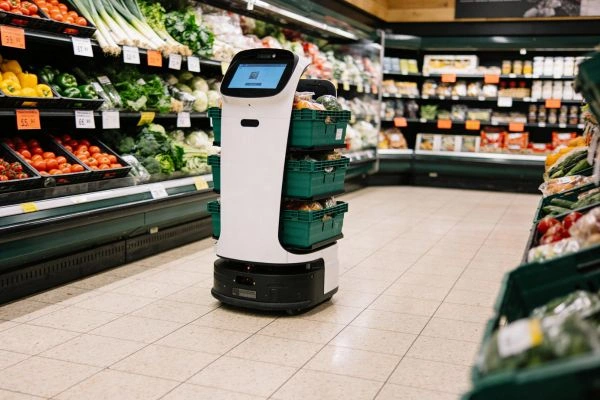
China’s first robot mall, opened in Shenzhen, showcases interactive robots in retail and hospitality roles. Robots in this environment act as shopkeepers, baristas, and receptionists, handling customer interactions with advanced AI and real‑time responsiveness. This development offers a glimpse into how robots could reshape service industries by blending physical presence with automated intelligence.
Service robots like these can greet customers, handle transactions, and even prepare simple food items. Their presence in a public retail space demonstrates growing confidence in robotic systems to operate reliably alongside humans. As consumer expectations for convenience rise, interactive robots in service roles offer a vision of the future where automated assistants and human staff work together.
Humanoid Robots Advancing Interaction
6. Realbotix Interactive Humanoid Robots
Interactive humanoid robots represent a major step forward in AI‑powered robotics. Realbotix, a leader in this field, presented multiple humanoid robots at CES 2026, featuring next‑generation interactive AI and lifelike expressions. These robots are designed to engage in natural conversations, recognize gestures, and respond to environmental cues through advanced vision systems and embedded AI.
At CES, Realbotix also demonstrated autonomous conversations between humanoid robots, with the robots interacting without human input. This breakthrough highlights how interactive AI can enable robots to operate in collaborative contexts and understand complex language across multiple languages.
Robots like these illustrate how embodied AI combines perception, language understanding, and social cues to create engaging interactions. As humanoid robots become more capable, they may be deployed for customer service, companionship, and in dynamic environments that require social awareness.
7. SwitchBot Onero Household Robot
SwitchBot introduced a different form of humanoid interaction with its Onero H1 household assistant. While not fully humanoid, the robot features articulated arms and tactile perception systems that allow it to handle everyday chores such as laundry and kitchen tasks.
This robot bridges the gap between single‑purpose devices and general‑use interactive systems. By combining AI perception with dexterous manipulation, it can perform tasks that require fine motor control and contextual understanding, such as folding clothes or operating kitchen appliances. These capabilities illustrate the growing potential for robots to support independent living and everyday convenience.
8. Samsung Ballie AI Companion Robot
Samsung’s Ballie robot represents another example of an AI‑powered interactive device designed for domestic environments. Showcased at previous technology expos, Ballie can connect with smart home systems to control devices, deliver notifications, and provide a mobile, interactive presence within the home.
Ballie’s duties go beyond simple automation by integrating voice commands and audiovisual feedback into a mobile robotic platform. Its release reflects a broader trend in which interactive robots serve as personal assistants that tie together smart devices and human needs. These kinds of robots promise a future in which physical AI integrates directly into daily life and routines.
Industrial and Commercial Applications
9. Skild AI Model for Generalized Robot Intelligence
AI models developed for multi‑purpose robots are expanding possibilities in industrial and commercial sectors. A model known as Skild Brain, backed by Amazon and SoftBank, enables robots to perform a wide range of human‑like tasks such as navigating complex environments and interacting with cluttered spaces.
By providing a common intelligence foundation shared across robot types, this approach reduces the need for bespoke programming for each new task. Industrial systems can adapt to diverse duties such as logistics support, warehouse management, and automated inspection. The use of these AI models signals a shift toward adaptable robotic systems that can be repurposed for new challenges.
10. Gemini Robotics Vision‑Language AI
Another notable development in robotics AI is the vision‑language‑action model created by Google DeepMind and partners. This architecture allows robots to connect perceptual understanding with language comprehension and purposeful action.
In industrial and research environments, such AI frameworks can help robots navigate unfamiliar layouts, interpret complex commands, and collaborate actively with human operators. These capabilities are key to making robots more versatile and effective across a range of non‑structured settings.

Ethical and Social Considerations
The rise of AI‑powered interactive robots also raises ethical and social questions. Concerns around job displacement, privacy, and safety are common when robots begin to operate in public and private spaces. Research and industry leaders emphasize collaboration between humans and machines rather than replacement, with humans often taking supervisory, creative, or maintenance roles as robotics evolves.
Ensuring that interactive robots behave in predictable, safe ways remains a central challenge. Standards for AI safety, transparency in decision‑making, and robust data protection will be essential as these technologies become widespread. Policymakers, manufacturers, and communities must work together to create frameworks that support innovation while minimizing risk.
The Future of AI‑Powered Interactive Robots
Looking ahead, AI‑powered interactive robots will continue to shape how society works, learns, and interacts. Continued enhancements in embodied AI, sensor technology, and adaptive learning will enable robots to function in increasingly complex roles. From home companions to industrial assistants, the influence of these machines will deepen as they become more capable, responsive, and integrated into human life.
As the robotics landscape evolves, consumers and industries alike can expect robots that understand natural language, perceive nuanced contexts, and collaborate with people in meaningful ways. This future reflects not only technological innovation but also a shift in how humanity conceptualizes machines, learning, and interactive intelligence together.
How Interactive Robots Are Shaping the Modern World
AI‑powered interactive robots are transforming the boundaries of what machines can achieve. By combining AI perception, decision‑making, and adaptive interaction, these robots are more than automated tools. They can understand and respond to humans, adapt to new environments, and perform tasks that enhance daily life and professional operations.
From homes and hospitals to factories and public spaces, AI‑driven robots are creating new opportunities for efficiency, convenience, and engagement. As research and consumer products continue to evolve, interactive robotics promises to deliver exciting and impactful innovations for years to come.